Spanish Conversation
How to Ask for Directions in Spanish: Key Phrases for Navigating Cities
Lost in a new city? Learn the essential Spanish phrases you need to ask for directions, understand the answers, and navigate Spanish-speaking countries with confidence.
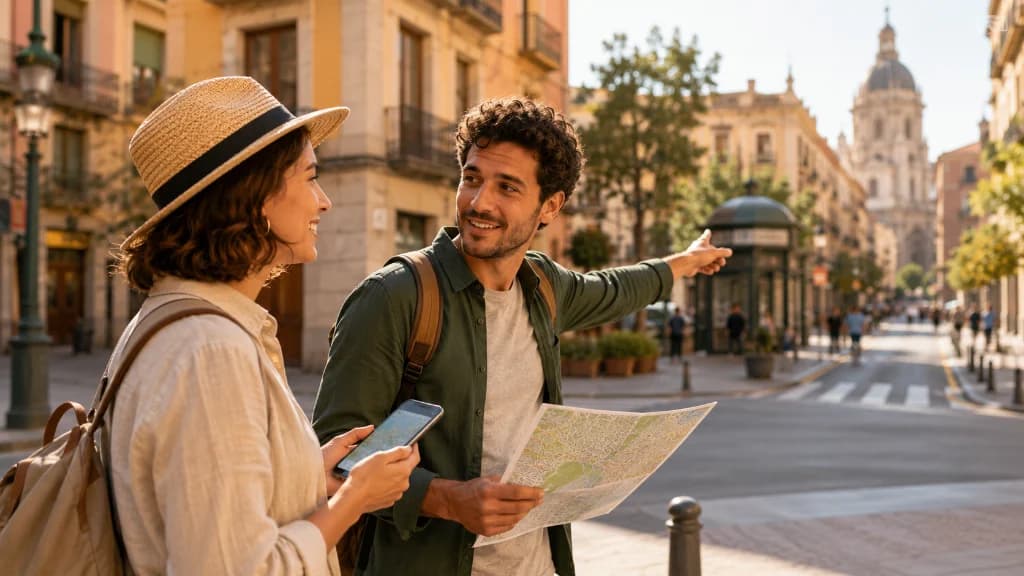
You've just arrived in a beautiful Spanish-speaking city. You're trying to find that famous museum everyone told you about, but your phone has just died. You look around, see the winding streets, and feel a small wave of panic. How do you find your way?
Knowing how to ask for directions is one of the most practical skills you can learn for traveling. This guide will give you the essential words and phrases to confidently ask for directions in Spanish and—just as importantly—understand the answers you receive. Let's get you ready for navigating Spanish cities like a pro.
Step 1: Getting Someone's Attention Politely
Before you can ask where to go, you need to politely get someone's attention. In Spanish, you can't go wrong with these simple phrases:
- Perdón. (Excuse me / Pardon me.) - A general, all-purpose way to start a conversation.
- Disculpe. (Excuse me.) - Slightly more formal, perfect for addressing strangers.
Simply start with one of these, make eye contact, and smile. For example: Disculpe, ¿me puede ayudar? (Excuse me, can you help me?).
Step 2: Asking the Main Question: "Where is...?"
Once you have someone's attention, it's time to ask your question. The most fundamental phrase you need to know is ¿Dónde está...?, which means "Where is...?". This is your go-to for asking about a specific place.
- ¿Dónde está el museo? (Where is the museum?)
- ¿Dónde está la estación de tren? (Where is the train station?)
- ¿Dónde está el baño? (Where is the bathroom?)
Another incredibly useful alternative is ¿Cómo llego a...?, which means "How do I get to...?".
- ¿Cómo llego a la Plaza Mayor? (How do I get to the Plaza Mayor?)
Step 3: Essential Vocabulary for Places and Navigation
To ask your question effectively, you'll need the right vocabulary. Here are some common words for places and landmarks you might be looking for while navigating Spanish cities.
| Spanish Word | English Meaning |
|---|---|
| la calle | the street |
| la avenida | the avenue |
| la plaza | the square |
| la esquina | the corner |
| el semáforo | the traffic light |
| el metro | the subway |
| la parada de autobús | the bus stop |
| el hotel | the hotel |
| el restaurante | the restaurant |
| el banco | the bank |
| la farmacia | the pharmacy |
Step 4: Understanding the Answers They Give You
Asking the question is only half the battle! You also need to understand the response. Locals will use a common set of phrases to give you directions. Listen for these keywords.
- Siga / Vaya todo recto. - Go straight ahead.
- Gire / Doble a la derecha. - Turn right.
- Gire / Doble a la izquierda. - Turn left.
- Cruce la calle. - Cross the street.
- Está a la derecha. - It's on the right.
- Está a la izquierda. - It's on the left.
- Está a dos cuadras. - It's two blocks away. (In Spain, you might hear
manzanasinstead ofcuadras.) - Está cerca. - It's close.
- Está lejos. - It's far.
- Al final de la calle. - At the end of the street.
Real-Life Examples of Spanish Directions Phrases
Let's put it all together. Here are some mini-conversations you might have on the street.
1. You: Perdón, ¿dónde está la farmacia más cercana?
(Excuse me, where is the nearest pharmacy?)
Local: Siga todo recto una cuadra y gire a la derecha.
(Go straight for one block and turn right.)
2. You: Disculpe, ¿cómo llego al Museo del Prado?
(Excuse me, how do I get to the Prado Museum?)
Local: Tome la segunda calle a la izquierda. El museo está al final.
(Take the second street on the left. The museum is at the end.)
3. You: ¿Está lejos la estación de metro?
(Is the metro station far?)
Local: No, está muy cerca. Está en esa esquina.
(No, it's very close. It's on that corner.)
4. You: Disculpe, ¿hay un banco por aquí?
(Excuse me, is there a bank around here?)
Local: Sí, cruce la calle. El banco está a la izquierda, al lado del restaurante.
(Yes, cross the street. The bank is on the left, next to the restaurant.)
Common Mistakes English Speakers Make
1. Forgetting Articles (`el`, `la`). English speakers often forget the Spanish articles el or la (the). It's a small word that makes a big difference in sounding natural.
Incorrect: `¿Dónde está estación de tren?`
Correct: ¿Dónde está **la** estación de tren?
- Pronouncing "Calle" Incorrectly. The double "LL" in Spanish typically sounds like the "y" in "yes," not like an "l." So,
callesounds like "CAH-yeh."
3. Mixing Up `derecho` and `derecha`. These two look similar but have different meanings.
`derecha` (with an 'a') means "right" (the direction).
derecho (with an 'o') means "straight" (as in todo derecho - straight ahead).
Quick Reference Chart
Save this chart on your phone! It’s a perfect cheat sheet for all the essential Spanish travel phrases you'll need for directions.
| English Phrase | Spanish Phrase |
|---|---|
| Excuse me. | Perdón. / Disculpe. |
| Where is the...? | ¿Dónde está el/la...? |
| How do I get to...? | ¿Cómo llego a...? |
| Is it far/close? | ¿Está lejos/cerca? |
| Go straight. | Siga todo recto. |
| Turn right. | Gire a la derecha. |
| Turn left. | Gire a la izquierda. |
| It's on the right/left. | Está a la derecha/izquierda. |
| It's X blocks away. | Está a X cuadras. |
| Cross the street. | Cruce la calle. |
Mini Practice
Test your new knowledge! How would you say or understand the following?
- How do you ask, "Excuse me, where is the hotel?"
- A local tells you:
Siga todo recto dos cuadras y gire a la izquierda.What should you do? - How would you translate this direction into Spanish: "It's on the corner, on the right."
Answers
Perdón, ¿dónde está el hotel?- You should go straight for two blocks and then turn left.
Está en la esquina, a la derecha.
You now have a solid foundation for how to ask for directions in Spanish. Don't be afraid to make mistakes—most people will appreciate your effort to speak their language and will be happy to help.
Keep these phrases handy for your travels, and remember that every conversation is a chance to practice. To build even more confidence for real-world situations, check out the interactive lessons and conversation practice on HolaLingo. ¡Buen viaje!